
The Louvre is the largest art museum in the world, with more than 35,000 works on display across three enormous wings. It is also one of the easiest places in the world to feel exhausted, lost and strangely disappointed. The secret is simple: don’t try to see everything. Choose a route, give yourself a few hours, and allow yourself to truly enjoy what you do see.
What follows is a rough sketch of a three- to four-hour adventure through all three wings, from Renaissance masterpieces to ancient Egypt and Mesopotamia. In my pre-departure lectures, I provide a far more detailed guide, room by room, along with the stories behind these great works and many more.
Before you go
Book a timed ticket online well in advance, since entry is by reservation. The museum is closed on Tuesdays, and the first hour of the morning is the calmest time to visit. Download the Louvre’s map before you arrive, and wear comfortable shoes, because you will walk several miles without noticing. Most of the essential works are in the Denon wing, so that is where we will start.
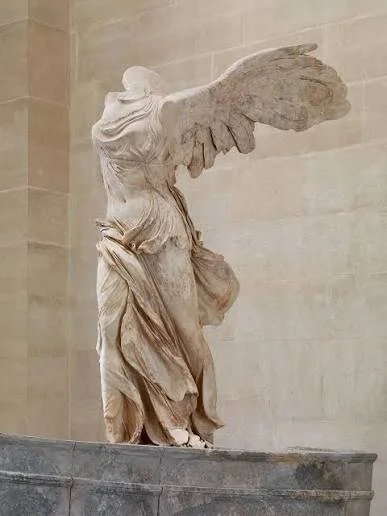
Winged Victory of Samothrace
The Daru Staircase and the Winged Victory
Climb the grand Daru Staircase, and at the top you will meet the Winged Victory of Samothrace, carved more than 2,000 years ago to celebrate a victory at sea. This spectacular and highly celebrated statue stands on the prow of a ship, her wings spread and her robes pressed against her body by a wind you can almost feel. As you walk slowly around this work, you will notice how she seems to be stepping forward into the air. No photograph prepares you for her scale or her sense of motion.
The Grande Galerie and the Mona Lisa
Turn right into the Grande Galerie, the long, sunlit hall of Italian painting. This is where many visitors rush past masterpieces on their way to the Mona Lisa, so be sure to slow down and notice Leonardo’s Virgin of the Rocks and his Saint John the Baptist, as well as the Madonnas of Raphael.
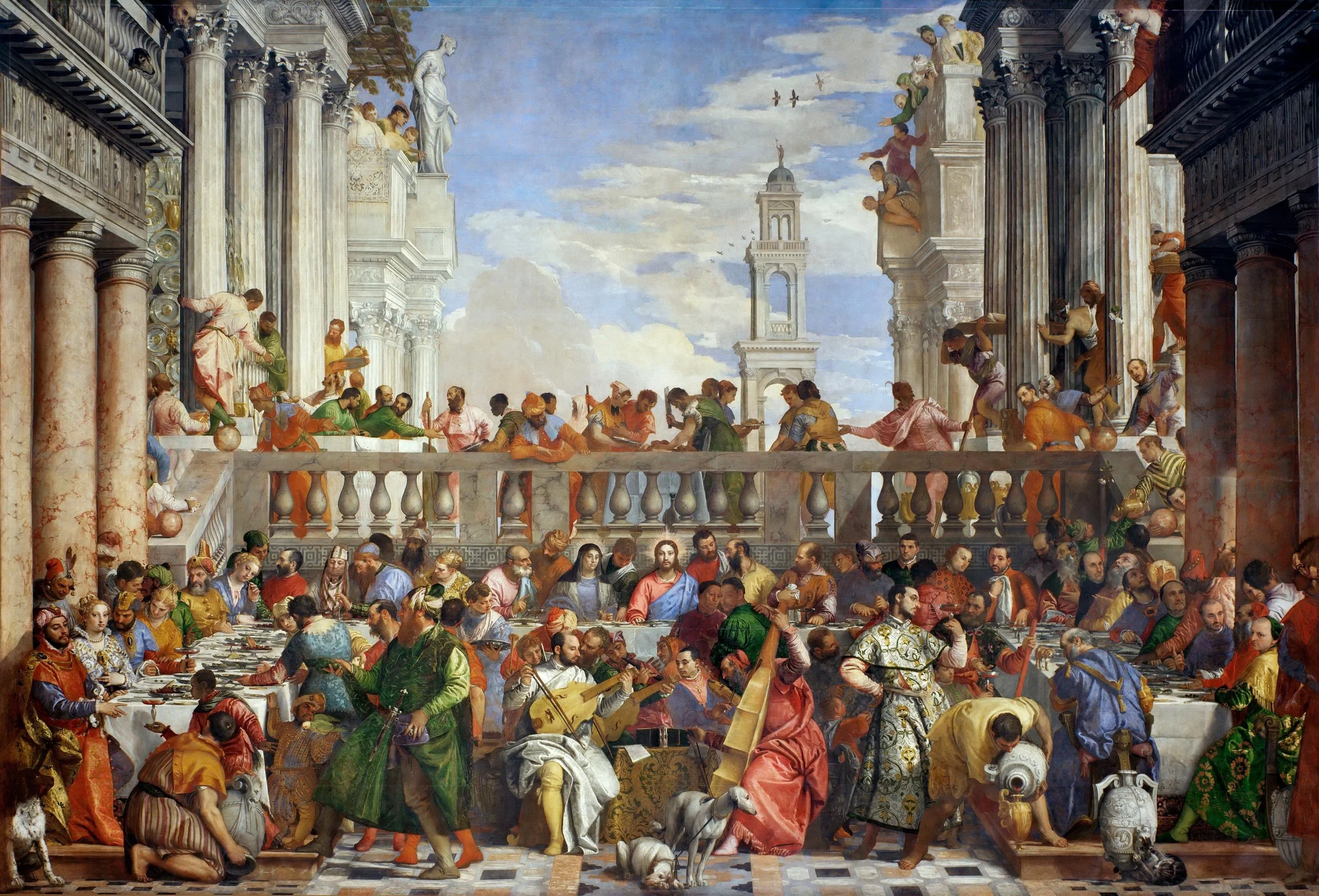
Wedding Feast at Cana
The Mona Lisa hangs nearby, in the Salle des États, behind glass and a crowd. Take your moment with her, then turn around. On the opposite wall hangs Veronese’s Wedding Feast at Cana, the largest painting in the Louvre, filled with more than a hundred figures. Most visitors never notice it, and it is one of the most spectacular paintings in the building.
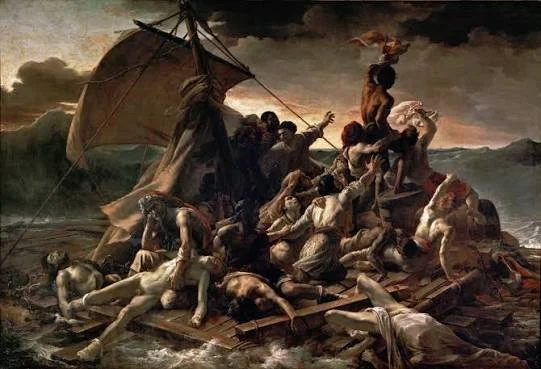
Raft of the Medusa
The great French paintings
Just beyond are the vast canvases of 19th-century France. Géricault’s Raft of the Medusa turns a shipwreck into a story of despair and hope, as the survivors reach toward a tiny ship on the horizon. Delacroix’s Liberty Leading the People captures the 1830 revolution in a surge of smoke and flags. Nearby, David’s Coronation of Napoleon fills an entire wall with imperial splendor. Stand back to see the whole composition, then step close to find the faces.
Michelangelo and the Italian sculptures
Head downstairs to Michelangelo’s two Slaves, figures that seem to be struggling free of the marble itself. Left unfinished, they show the sculptor’s hand at work, and remind us that every masterpiece begins as a block of stone.
The Venus de Milo
Cross into the Sully wing to find the Venus de Milo, the most famous sculpture of the ancient world. Discovered on the Greek island of Melos in 1820, she has been admired for two centuries, and much of her mystery comes from what is missing. Walk around her slowly, as she was meant to be seen.
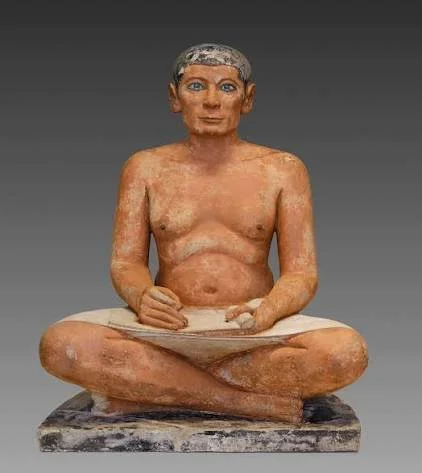
Seated Scribe
Ancient Egypt
Nearby, the Egyptian galleries are a world unto themselves. One of my favorite pieces is the Seated Scribe, more than 4,500 years old with eyes inlaid with rock crystal. Notice how they seem to follow you across the room. On the lower level, the massive Great Sphinx of Tanis guards the entrance to galleries filled with painted coffins, jewelry, tools and everyday objects that bring an ancient civilization startlingly close.
The medieval Louvre
While you are on the lower level, step into the medieval foundations, the remains of the fortress that stood here more than 800 years ago. Walking along the old moat beneath the museum, you begin to understand that the Louvre itself is one of its greatest works of history.
Time for a break
By now you will have earned a rest. Inside the museum, the cafés offer coffee and a pastry with a view. For a full meal before or after your visit, the food court in the Carrousel du Louvre, just off the main entrance hall, serves cuisines from around the world in a relaxed setting. I have many more lunch suggestions near the Louvre (see post: Lunching Near the Louvre).
The Code of Hammurabi and ancient Mesopotamia
After a break, continue into the Richelieu wing and its galleries of the ancient Near East. Here stands the Code of Hammurabi, a towering black stone inscribed nearly 4,000 years ago with one of the earliest written legal codes in history, the source of the famous “eye for an eye.” Nearby, the enormous winged bulls of the Assyrian palace at Khorsabad, human-headed guardians more than 13 feet tall, are one of the most breathtaking sights in the museum.
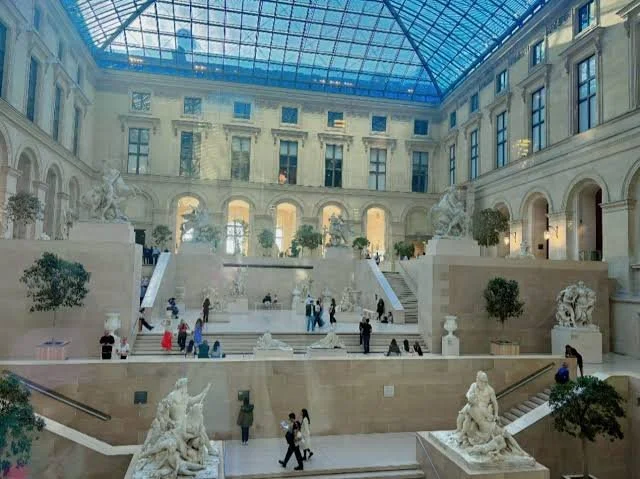
Cour Marly
The sculpture courtyards
Just steps away are the Cour Marly and Cour Puget, two glass-roofed courtyards that feel like an indoor sculpture garden. Notice Coustou’s rearing Marly Horses, carved for Louis XV, and Coysevox’s winged horses carrying Fame and Mercury. Also a favorite is Pierre Puget’s Milo of Croton, the legendary strongman trapped as a lion attacks. Bathed in natural light, the courtyards are a peaceful place to relax.
The Napoleon III Apartments
If you have time for one final treasure, climb upstairs to the opulent Napoleon III Apartments, a dazzling suite of chandeliers, gilded ceilings and red velvet. They are often blissfully quiet, and a wonderful contrast to the crowds downstairs.
A few final tips
Plan on three to four hours, not a whole day, and take a break halfway through. Choose a few works to truly look at rather than trying to photograph everything. And remember that you can always come back. Seeing a few works well is far better than seeing everything in a rush.
This route is only the beginning. In my private pre-departure lectures, I take you through the Louvre and the Musée d’Orsay in much greater detail: the best order to see the works, what to look for in each one, and the remarkable stories behind them. You arrive knowing exactly what to see and why it matters.
